
If you have heard the name Gallus Meg on a Wilmington ghost tour, the story is hard to forget. In the familiar version, she is a huge, red-haired woman who controlled a rough waterfront establishment, threw troublesome sailors into the street and sometimes bit off an ear for good measure.
It sounds perfectly suited to an old port city. The problem is that the deeper you look, the less secure the Wilmington part of the story becomes.
The short answer: Gallus Meg is a real Wilmington legend, but she is not a well-documented Wilmington historical figure. Local archaeology confirms that the riverfront around Quince Alley really did contain taverns and other businesses serving a busy port. What it has not produced is a clear historical record tying a woman named Gallus Meg to that district. Meanwhile, a strikingly similar woman called Gallus Mag appears in 19th-century records from New York City.
What Does the Wilmington Gallus Meg Legend Say?
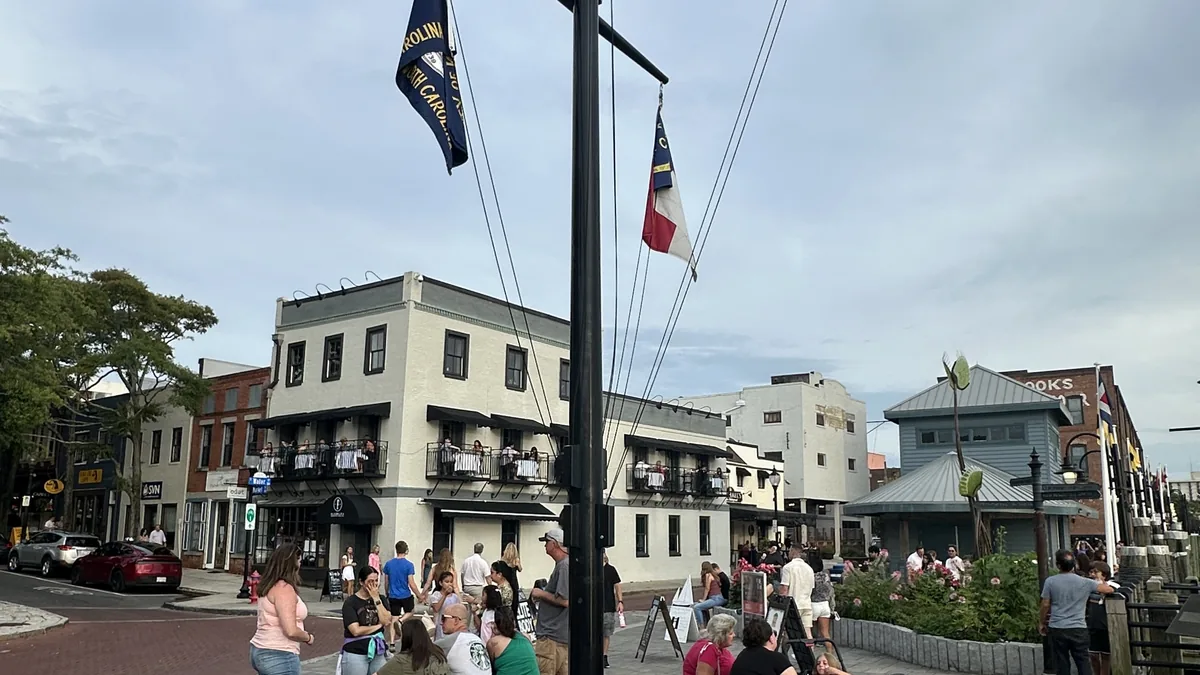
Modern Wilmington versions usually place Meg somewhere near the old waterfront, often around Quince Alley or the area historically associated in storytelling with the “Blue Post.” She is described as unusually tall and strong, capable of removing unruly customers without help.
The most dramatic part is the ear story: Meg supposedly bit the ears of men who caused trouble and kept the severed pieces in a jar as a warning to others. Later ghost lore adds another layer, claiming that her presence can still be felt around the old waterfront.
Those details make excellent folklore. They are much harder to prove as biography.
The Waterfront Behind the Legend Was Very Real
The weakness of the Gallus Meg evidence does not mean Wilmington’s old waterfront was invented by ghost-tour writers. Quite the opposite. Recent archaeological and archival work around Quince Alley has documented a lively commercial district with businesses serving sailors, travelers and local residents.
The Public Archaeology Corps has combined excavation with New Hanover County court records, deeds, early maps and newspapers to reconstruct the block’s history. Its published research says that as many as five or more licensed taverns or ordinaries may have operated near Quince and Henderson alleys between the 1750s and 1840s.
One of the best documented was James Jennet’s tavern. County records show that Jennet received a license to keep an ordinary in 1792 and renewed it in later years. A 1798 newspaper advertisement described the Quince Alley property as a “well frequented Tavern.” The building was then destroyed in a major fire that year.
Other named operators appear in the surviving records too, including Garrett Cumberford. Archaeologists have recovered material that fits the everyday life of the waterfront district, while deeds and maps help locate former businesses.
This matters because it gives us something better than a generic “rough old port” backdrop. The setting was real and can be studied in records and in the ground. But in the published archaeological research reviewed for this article, Gallus Meg is not one of the documented proprietors.
 Photo credits
The New York Gallus Mag Problem
The biggest reason to be cautious with the Wilmington story is that an extremely similar character appears in New York waterfront history.
On January 20, 1874, the Brooklyn Daily Eagle published an article about New York river thieves. It identified a woman called Gallus Mag alongside Kate Flannery as an associate of “One-Armed Charlie” Monell at the notorious Hole in the Wall in Manhattan’s Fourth Ward. That newspaper reference places the name in New York close to the period in which the woman was said to have lived.
Decades later, Herbert Asbury’s 1928 book The Gangs of New York turned Gallus Mag into a much more theatrical figure. His version includes the now-famous ear-biting story and the jar of trophies. Modern historical re-examinations have found evidence that a woman known as Gallus Mag did operate in New York’s waterfront world, while many of Asbury’s most colorful details are much less secure.
That distinction is crucial. A historical person can be real while the most memorable stories about that person are exaggerated or invented later.
Why the Wilmington and New York Stories Raise Red Flags
In 2014, maritime writer Rick Spilman compared the two traditions and pointed out how closely they match: same unusual name, same waterfront setting, same imposing woman and the same ear-biting detail. He found contemporary documentation for the New York Gallus Mag but could not find comparable evidence for Wilmington.
A 2024 News & Observer report went further by asking local storytellers about the problem. The owner of Wilmington’s Ghost Walk told the newspaper that the Gallus Meg story here had circulated by word of mouth, while the article noted how closely it echoes the New York account.
More recently, local reporting on archaeological work at Quince Alley has contrasted the popular Gallus Meg/“Blue Post” story with what researchers are finding in deeds, tax records, newspapers and artifacts. The real history has plenty of colorful characters; it simply does not currently provide a strong documentary trail for Meg.
So Was Gallus Meg Ever in Wilmington?
There are three possibilities:
- A Wilmington woman inspired the legend, but the confirming records have not been found. Missing records are common in early local history, so absence of evidence is not absolute proof that no such person existed.
- A real local character was gradually merged with the better-known New York Gallus Mag story. Oral traditions often absorb details from other stories over time.
- The Wilmington version is largely borrowed folklore. The near-duplicate name and ear-jar detail make this a serious possibility, especially because the New York version has a much clearer documentary trail.
At present, the evidence supports caution rather than certainty. The most accurate wording is that Gallus Meg is a Wilmington waterfront legend whose local historical identity remains unverified.
What About the “Blue Post” and Paradise Alley?
These names often get folded into the Gallus Meg story, but the archaeology is more complicated than the legend.
Quince Alley and nearby passages are genuinely old. Wilmington itself was incorporated in 1739–40, and by the late 18th century the block contained documented establishments and lodging businesses. Fires repeatedly reshaped the waterfront, destroying buildings and changing property use.
The Public Archaeology Corps has been able to identify actual business owners and approximate sites from surviving records. That work is more useful than assuming that every old doorway or alley in the modern streetscape belonged to the Gallus Meg story.
For visitors interested in Wilmington history, this is the more rewarding way to look at the area: the alleys are not interesting because a ghost story needs them. They are interesting because archaeology and archival research are still reconstructing the lives of people who actually worked there.
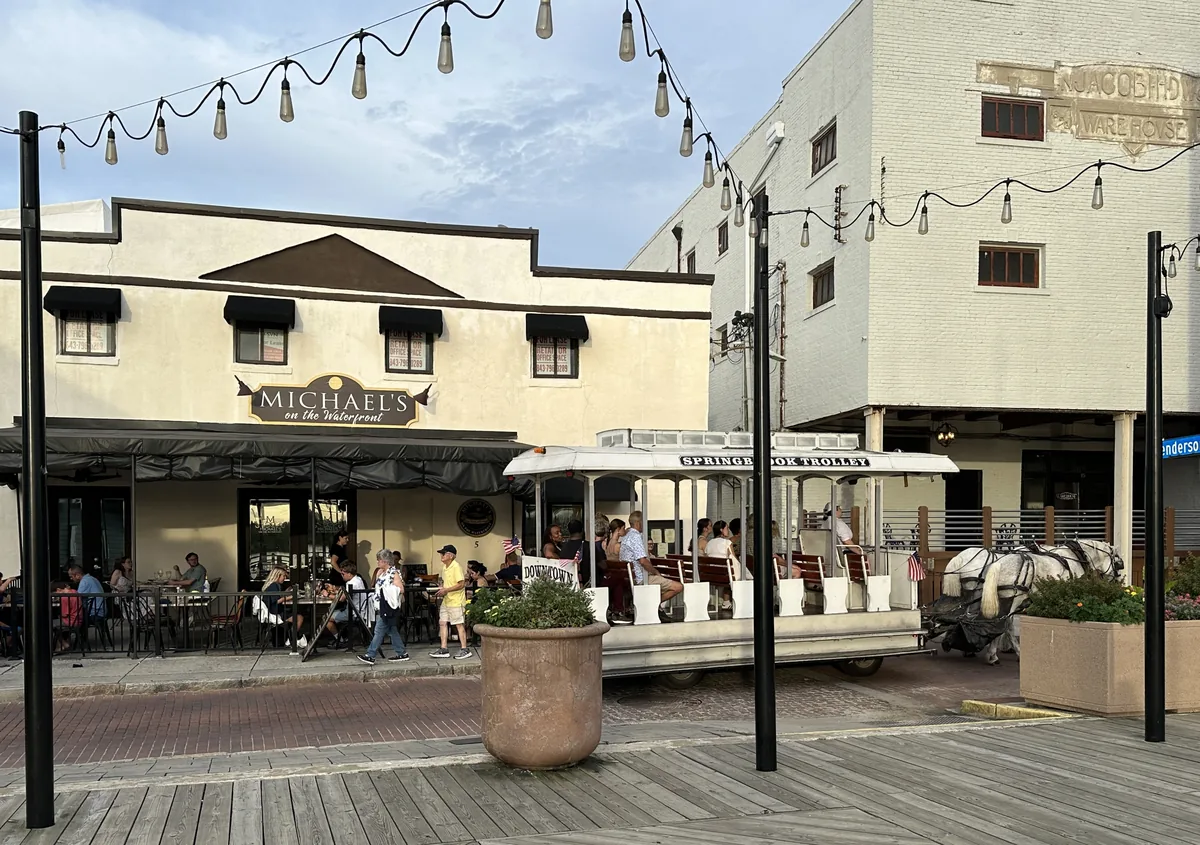 Photo credits
Is Gallus Meg’s Ghost Supposed to Haunt the Waterfront?
Yes, in local ghost lore. Reports commonly describe a strong female presence, shadows, unexplained sensations or the idea that Meg is still “keeping order.” These are anecdotes, not historical evidence.
There is no reliable way to verify a paranormal claim of that kind, and there is an added problem here: if the Wilmington identity of Gallus Meg is itself uncertain, then claims about her specific ghost deserve even more caution.
That does not make the story useless. It simply changes what kind of story it is.
Why Keep Telling a Legend That May Be Borrowed?
Because folklore has history too.
The interesting question is no longer just “Did Gallus Meg bite sailors’ ears?” A better question is how did a New York waterfront character—or a story remarkably similar to one—become attached to Wilmington?
That tells us something about how port cities remember themselves. Old waterfront districts share the same ingredients: ships, transient workers, fires, crime, crowded lodging, commerce and generations of storytelling. A larger-than-life enforcer fits that landscape so well that the story can feel true even when the paper trail is weak.
This is the same reason it helps to separate the documented core from the supernatural layer in stories such as the Maco Light or Gallows Hill. The history is often more interesting once we stop forcing every detail into either “100% true” or “100% fake.”
What Should a Visitor Take Away?
If you encounter Gallus Meg in a Wilmington ghost story, enjoy the character—but keep the labels straight:
- Documented: Wilmington was a major port, Quince Alley is historic, and archival and archaeological evidence confirms multiple businesses serving the old waterfront district.
- Documented elsewhere: a woman called Gallus Mag appears in 19th-century New York reporting.
- Unverified in Wilmington: a specific local Gallus Meg with the biography repeated in modern ghost lore.
- Folklore: the ear collection, exaggerated physical descriptions and paranormal encounters attributed to her in Wilmington.
That version may sound less sensational, but it is actually more distinctive. Instead of repeating a legend word for word, it lets Wilmington’s real archaeology sit beside the story and shows exactly where the mystery begins.
For more stories examined this way, see our Wilmington ghost stories and local legends guide.
Frequently Asked Questions
Was Gallus Meg a real person in Wilmington?
No reliable local record has yet established the Gallus Meg of modern Wilmington lore as a historical Wilmington resident or business operator. She should be described as a local legend unless stronger evidence emerges.
Was there really a Gallus Mag in New York?
Yes, the name appears in an 1874 Brooklyn Daily Eagle account of New York’s waterfront underworld. Later retellings added much more dramatic material, so even the New York story requires separating contemporary evidence from later folklore.
Did Gallus Meg really bite off ears?
There is no solid contemporary evidence that a Wilmington Gallus Meg did this. The ear-biting and trophy-jar story became famous through later accounts of New York’s Gallus Mag and is best treated as folklore.
Was Quince Alley historically part of Wilmington’s waterfront district?
Yes. Archaeological and archival research documents businesses there from the colonial and early national periods, including licensed taverns and other commercial uses. The alley’s history is real even if the Gallus Meg connection is uncertain.
Sources & Research Notes
This article separates contemporary or archival evidence from later storytelling. A source appearing here does not mean every detail it repeats is verified; sources are used according to what they can actually establish. Source check: September 6, 2026.
- Public Archaeology Corps — History of Our Finds: archaeological and archival research on Quince Alley, including documented tavern keepers, property history and the 1798 fire.
- Encore — Dig Into History: recent reporting on the Quince Alley excavation and the gap between the popular “Blue Post” story and documented local history.
- The News & Observer — Gallus Meg in Wilmington: 2024 reporting on the local legend and its striking similarity to New York’s Gallus Mag tradition.
- Old Salt Blog — Will the Real Gallus Mag, or Meg, Stand Up?: comparison of the Wilmington and New York traditions, including the 1874 Brooklyn Daily Eagle reference.
- Herbert Asbury — The Gangs of New York (1928): influential later account that popularized many of the most dramatic Gallus Mag details.