
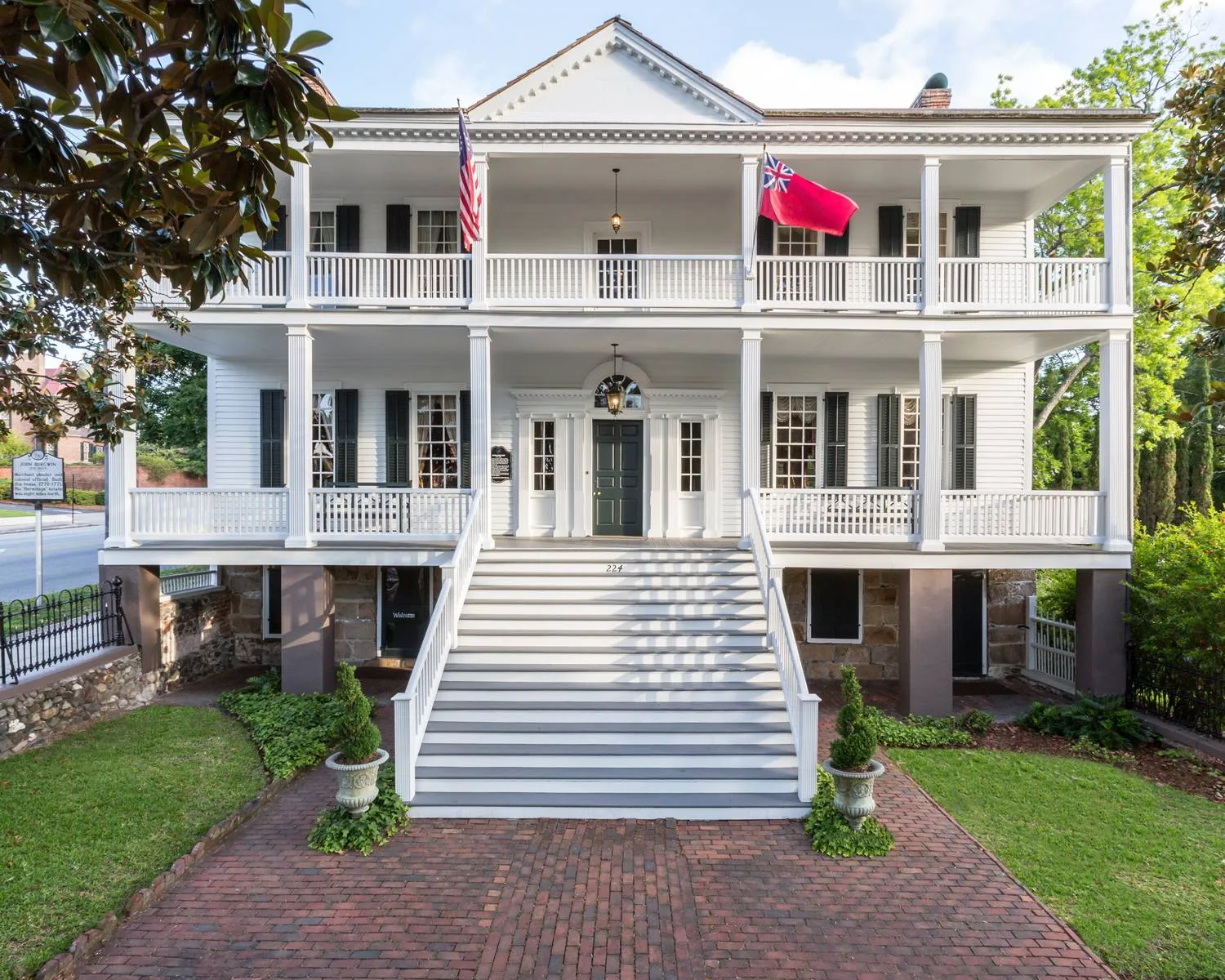
The Burgwin-Wright House is one of the easiest places in downtown Wilmington to see two very different layers of the city’s past in the same building. The elegant townhouse dates to 1770, but beneath it are surviving parts of Wilmington’s first city jail, established on the site in 1744.
That combination—colonial architecture above, old jail fabric below—has also made the property a natural setting for ghost stories. The history is well documented. The paranormal claims are not, and they are best understood as part of Wilmington’s local folklore rather than proof that the house is haunted.
Why the Burgwin-Wright House Is Historically Important
The property began as Wilmington’s first city jail, or gaol, around 1744. After the jail roof burned in 1768, merchant and colonial official John Burgwin acquired the site. His townhouse was completed around 1770, using the old jail’s ballast-stone walls as part of the foundation and retaining the former jailer’s quarters as a detached kitchen building.
Burgwin was a prominent merchant and planter who held several public positions in colonial North Carolina. He also remained loyal to the British Crown as the Revolution approached. The official Burgwin-Wright House history traces both his ownership and the later Wright family period, giving the site a documented story that stretches well beyond its ghost-tour reputation.
The Old Jail Beneath the House
The jail connection is not a legend. The museum describes the property as a dual historic site: a colonial townhouse and surviving portions of the earlier jail complex. Ballast-stone construction, outdoor cells and sub-basement jail spaces remain part of the property today.
For visitors, this is the feature that most clearly separates the Burgwin-Wright House from Wilmington’s other historic homes. You are not simply looking at a restored eighteenth-century residence; you are also seeing physical remains of the city’s early criminal-justice system.
The museum’s current interpretation also looks beyond famous owners. Exhibits address the free and enslaved people who lived and worked on the property, colonial labor, and the legal system connected to the old jail. That broader context is more useful than treating the basement simply as a “haunted dungeon.”
Did Lord Cornwallis Use the House as His Headquarters?
This is one of the most repeated claims about the Burgwin-Wright House, and it needs a correction. British forces captured Wilmington during the Revolutionary War, and Lord Cornwallis was in the city for about three weeks in 1781. But the museum’s documented history says he used the house for one evening to entertain his officers because of its size, location and prestige.
That brief visit helped produce the old local nickname “The Cornwallis House.” It does not support the stronger claim that the building served as Cornwallis’s headquarters. Keeping that distinction matters because the real story is interesting without embellishment.
Who Lived at the Burgwin-Wright House?
John Burgwin built the house, but the Wright family became central to its later history. Burgwin sold the property in 1799 to Joshua Grainger Wright, whose family had already been connected to the house. The property remained associated with the Wright family for much of the nineteenth century.
One later owner, Thomas Henry Wright, enlarged and restored the house in 1845. The building therefore reflects more than one period of Wilmington history rather than being a perfectly frozen 1770 interior.
How the House Was Saved
By 1930, the property was in poor condition and faced an uncertain future. Plans were discussed that could have led to the house being removed or the lot being used for a gas station. The National Society of the Colonial Dames of America in the State of North Carolina led a preservation effort and purchased the property in 1937.
Restoration continued over a long period, interrupted by World War II, and the house opened to the public as a museum in 1951. That preservation history is part of why visitors can still see the colonial structure and jail remains today.
So, Is the Burgwin-Wright House Haunted?
There is no historical method that can prove a building is haunted. What can be documented is that ghost stories and reports of unusual experiences have become part of the way people talk about the property.
The museum itself acknowledges that visitors frequently ask about ghosts. Rather than presenting paranormal stories as established facts, its Haunted Tales of the Cape Fear project examines the real history behind persistent local stories and asks why those stories survive. That approach is useful here: the old jail, the age of the house and more than two centuries of human history provide plenty of material from which folklore can grow.
If you encounter stories about apparitions, unexplained scents, cold spots or former prisoners still lingering at the property, treat them as reported experiences and local lore. They are part of the site’s cultural story, but they are not verified historical evidence.
What Visitors Can See Today
The Burgwin-Wright House and Gardens is at 224 Market Street in downtown Wilmington. According to the museum, guided visits cover the furnished house and the old jail areas, while the gardens and exhibit hall have self-guided options. Hours and access can change, so check the museum’s current information before visiting.
The property is especially worthwhile if you are interested in colonial Wilmington, architecture or the history behind the city’s ghost stories. Even without the paranormal layer, the surviving jail fabric and the 1770 house make it one of downtown Wilmington’s most distinctive historic sites.
FAQ: Burgwin-Wright House
When was the Burgwin-Wright House built?
The house was completed around 1770 for John Burgwin. It was built on the site of Wilmington’s first city jail, which dated to about 1744.
Can visitors see the old jail?
Yes. The museum interprets surviving jail features on the property, including ballast-stone construction and jail spaces beneath and around the house. Access can vary with the tour format, so current museum information is the best source before a visit.
Was the house Lord Cornwallis’s headquarters?
The museum does not describe it that way. Its history says Cornwallis used the house for one evening to entertain his officers while British forces occupied Wilmington in 1781. That episode helped create the nickname “The Cornwallis House.”
Is the Burgwin-Wright House really haunted?
Ghost stories and reports of strange experiences are associated with the property, and the museum has explored those stories in its own historical programming. They remain folklore and anecdotal reports, not verified evidence of paranormal activity.
Sources
- Burgwin-Wright House & Gardens — History: A Brief Overview
- Burgwin-Wright House & Gardens — Museum and Site Interpretation
- Burgwin-Wright House & Gardens — Haunted Tales of the Cape Fear
- Burgwin-Wright House & Gardens — Museum Timeline
Sources reviewed September 6, 2026. Museum hours, tour access and programs can change.