
Latimer House is one of the most recognizable historic homes in downtown Wilmington, North Carolina. Built in 1852, the four-story Italianate Revival house preserves the story of the Latimer family, nineteenth-century domestic life, and the wider history of the Lower Cape Fear region.
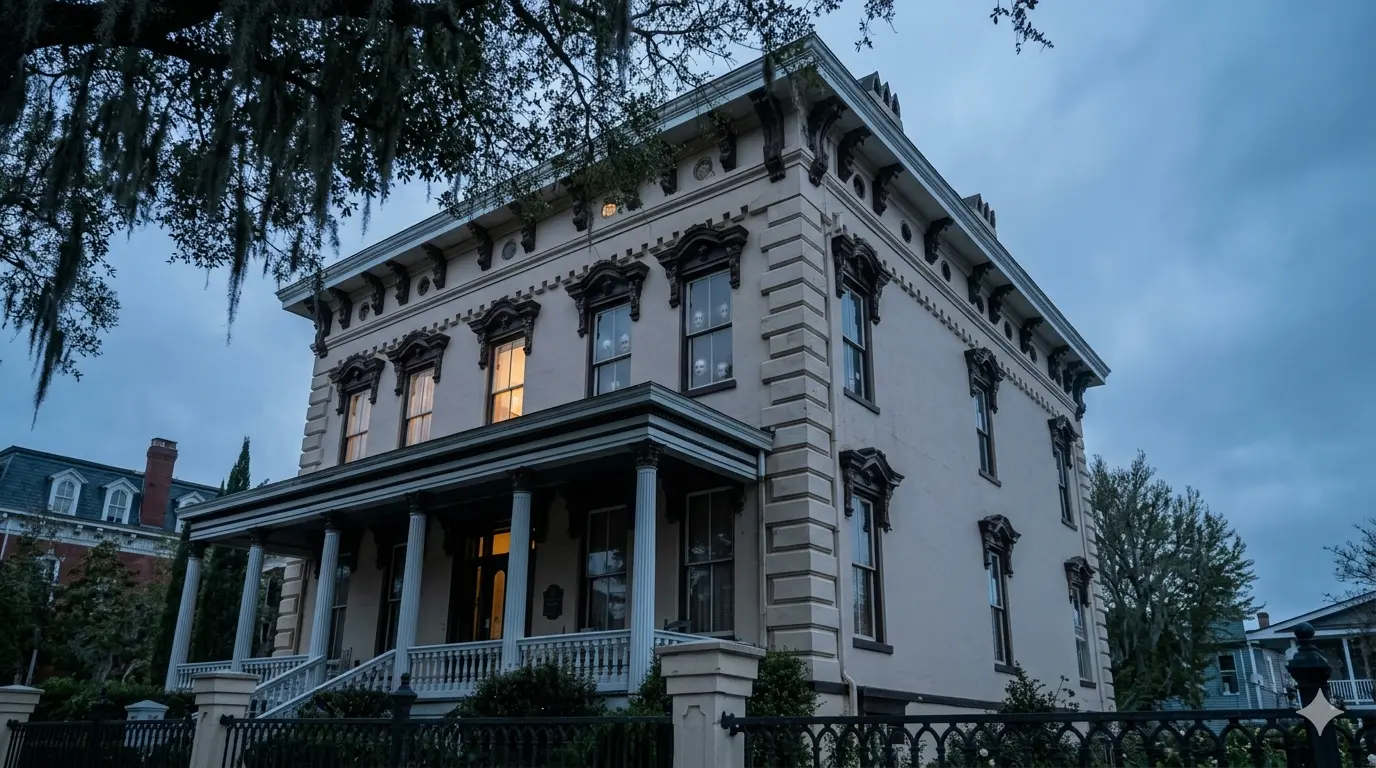
It is also a regular stop in Wilmington ghost stories. Tales of children, footsteps, crying, and uneasy sensations have circulated around the house for years. The important distinction is that the building's history is well documented, while the paranormal stories remain folklore and reported experiences rather than established fact.
Is the Latimer House Really Haunted?
There is no verified evidence that Latimer House is haunted. The property has a long paranormal reputation, and ghost-tour storytelling has connected the house with sounds and presences associated with children. A 2008 WECT feature on the Ghost Walk of Old Wilmington, for example, recorded a tour guide telling visitors about soft cries supposedly heard in the house.
That tells us the ghost story is genuinely part of Wilmington's local tourism tradition. It does not prove the source of any sound or experience. More recently, the Latimer House itself has hosted special events that examine the line between history and the paranormal, including a 2026 program called Shadows in the Parlor: History Meets the Paranormal, which invited visitors to learn the truth behind the site's tales and legends.
For a visitor trying to separate fact from folklore, the safest conclusion is simple: Latimer House has a documented haunted reputation, but the haunting itself is not a documented historical fact.
The Documented History of Latimer House
The house was constructed in 1852 for merchant Zebulon Latimer and his wife, Elizabeth Savage Latimer. The museum describes the building as an Italianate Revival residence designed around symmetry, with a central hallway and matching room arrangements across its floors.
Today the house contains 14 rooms and more than 600 historical objects, roughly half of which are original to the home. Those surviving objects make the property particularly useful for understanding how an affluent Wilmington household lived during the nineteenth century.
Zebulon Latimer built much of his wealth through his work as a commission merchant and investments in gas, lighting, and railroad companies. The house therefore represents a prosperous side of antebellum Wilmington, but the museum's interpretation is broader than the family's formal rooms. The grounds also include restored enslaved quarters, and archaeological material recovered there is preserved as part of the site's interpretation.
The Latimer House Museum's official history provides the clearest overview of the family, architecture, collections, and preservation of the property.
The Latimer Children: What the Record Actually Says
Family tragedy is central to many versions of the Latimer House ghost story, so this is one place where wording matters.
The museum states that Zebulon and Elizabeth Latimer had nine children and that only four sons survived to adulthood. That means five of their children died young, but the museum's public history does not establish that all five died inside Latimer House. It is therefore more accurate to say that the family experienced repeated childhood loss than to turn every death into an event that can be placed in a particular room.
The four sons who reached adulthood were Henry Gould Latimer, William Latimer, Edward Savage Latimer, and Herbert Russell Latimer. Their lives also connect the house to Wilmington's art, law, transportation, industry, and later generations of the family.
That documented family history helps explain why ghost-tour lore so often centers on children. But grief is historical context—not evidence that the children's spirits remain in the building.
Where the Ghost Stories Come In
Stories associated with Latimer House vary depending on the storyteller. Repeated themes include footsteps or running sounds on upper floors, crying or laughter attributed to children, figures or faces near windows, and a general sense of being watched.
These stories should be treated carefully. A television feature documenting a ghost walk proves that such tales were being told publicly; it does not verify the paranormal explanation. Likewise, a visitor's uneasy feeling is a real personal experience, but it cannot identify what caused it.
The house itself is unusually effective at creating atmosphere without any supernatural explanation. It is an old, largely preserved residence filled with family objects, narrow transitions between rooms, period furnishings, and layers of personal history. At night, the effect is even stronger: the museum offers a separate historical night tour using the glow of its gasoliers to interpret nineteenth-century gas technology and evening life.
That distinction makes Latimer House more interesting, not less. You can appreciate the ghost stories while still asking where each story originated and what the historical record actually supports.
From Family Home to Museum
Latimer House remained connected to the family for three generations. Later in its history, portions of the home were used for boarders, and artist Elisabeth Augusta Chant lived there while contributing to Wilmington's developing art community.
In 1963, Herbert Latimer Jr., the last Latimer generation to live in the mansion, sold the property to the Lower Cape Fear Historical Society. The society has operated it as a museum and historical resource ever since, preserving not only the house but also an archive focused on the Lower Cape Fear region.
The museum's collection and archive are an important reason to visit. Latimer House is not simply a spooky exterior on a walking-tour route; it is an active historical institution with original family material, research holdings, exhibitions, gardens, and educational programs.
What You Can See at Latimer House Today
A standard visit focuses on the history of the home and the people connected with it rather than on ghost hunting. Visitors see period rooms and objects, learn about several generations of the Latimer family, and can explore the gardens and interpretation of the restored enslaved quarters.
As of our September 2026 source check, the museum lists guided day tours at 10 a.m., 11 a.m., noon, 1 p.m., and 2 p.m., with each tour lasting about 50 minutes. The museum also notes that tours involve two flights of stairs, which is useful to know before arriving. Hours, prices, and special-event schedules can change, so confirm details on the official Latimer House tours page.
Address: 126 South Third Street, Wilmington, NC 28401.
Is Latimer House Worth Visiting for Ghost-History Fans?
Yes, especially if you prefer haunted history that has a real place and a substantial historical record behind it.
If you visit only for a promise of paranormal activity, the museum may not be what you expect. Its normal tours are historical, and no ghost sighting is guaranteed. But if you want to understand why an 1852 family home became part of Wilmington's haunted reputation, seeing the actual rooms, collections, gardens, and surviving service spaces gives the stories much more context.
Latimer House also pairs naturally with nearby historic sites. For another nineteenth-century Wilmington property with a very different Civil War story, see our guide to Bellamy Mansion.
Frequently Asked Questions
When was Latimer House built?
It was built in 1852 for Zebulon and Elizabeth Savage Latimer.
How many children did the Latimer family have?
Zebulon and Elizabeth had nine children. According to the museum, only four sons survived to adulthood.
Did five children die inside Latimer House?
The family lost five children before adulthood, but the museum's public history does not establish that all five died inside the house. Claims that place every death in the mansion go beyond what the cited historical source confirms.
Does the museum say Latimer House is haunted?
The museum acknowledges the site's paranormal reputation and has hosted programming about its tales and legends, but that is not the same as declaring a haunting proven. Ghost stories should be treated as folklore and reported experiences.
Can visitors go inside Latimer House?
Yes. Latimer House operates as a museum with guided tours. The standard tour lasts about 50 minutes and includes two flights of stairs.
Are the regular museum tours ghost tours?
No. Standard tours focus on the house, family, objects, and regional history. The museum also offers night tours centered on historic gas lighting and occasional special programs that may explore paranormal themes.
Sources & Further Reading
This article was fact-checked against the Latimer House Museum and Lower Cape Fear Historical Society's own materials, with a separate contemporary news source used to document the existence of local ghost-tour lore. Paranormal claims are presented as folklore or reported experiences, not established fact. Source check: September 6, 2026.
- Latimer House Museum and Gardens — Discover: construction date, architecture, collections, family history, enslaved quarters, and transfer to the Lower Cape Fear Historical Society.
- Latimer House Museum and Gardens — Daily House Tours: current tour format, duration, stairs, schedules, and night-tour information.
- Lower Cape Fear Historical Society Bulletin, May 1963: historical account of the Zebulon Latimer House and the society's proposed purchase of the property.
- WECT — Ghost Walk of Old Wilmington feature (2008): contemporary record of ghost-tour stories associated with Latimer House.